Why Your Air Purifier Isn’t Collecting Dust — And What to Check First
Air purifier troubleshooting has gotten complicated with all the conflicting advice flying around. You pop open your unit, stare at a filter that looks straight out of the box — white, pristine, not a speck on it — and your brain immediately jumps to: this thing is broken. As someone who spent months working through purifier complaints with frustrated homeowners, I learned everything there is to know about why these units seem to do nothing. Today, I will share it all with you. Because a clean filter doesn’t always mean failure. Sometimes it means your purifier is genuinely working. Sometimes something else is wrong entirely. The trick is knowing which situation you’re actually in.
Most people don’t figure out why their air purifier isn’t collecting dust until they’ve already boxed it back up for a return. The real answer isn’t visible from the filter alone. You have to run a proper diagnostic sequence — and I’ll walk you through exactly that.
First, Check If Your Unit Is Actually Pulling Air
Start here. Not with the filter. With the intake vents.
Grab a tissue. Hold it roughly six inches in front of your purifier’s intake grille. A working unit should pull it toward the vents — noticeably, not subtly. If nothing happens, or the pull feels barely perceptible, you’ve found your problem before we even crack open the device.
I made this exact mistake with a Levoit Core 300 I’d shoved inside a narrow bookshelf. The unit ran constantly. The display showed full operation. But the tissue test revealed almost zero airflow. The intake vents faced the back panel of the shelf, pulling from a dead zone where dust simply never circulated in the first place. That’s what makes placement so quietly destructive — the unit looks fine. It just isn’t doing anything useful.
Here’s what kills airflow in most homes:
- Placement flush against a wall or jammed into a corner
- Inside a cabinet or closet with minimal breathing room
- Surrounded by furniture blocking intake vents on multiple sides
- On the floor where curtains or rugs drape over the sides
Move the unit somewhere open. Intake vents — usually on the sides or back — need at least 12 inches of clear space around them. Run the tissue test again. Real airflow should pull that tissue with obvious, consistent force. If it does, you’ve solved the mystery. The filter stayed clean because air wasn’t cycling through properly. Move on to the next section. If airflow is still weak after repositioning, keep reading past it.
A Clean Filter Is Not Always a Bad Sign
Probably should have opened with this section, honestly. Most people assume a spotless filter means the purifier sat there doing absolutely nothing. That’s backwards.
A clean filter can mean the unit is doing exactly what it should. Think about your environment:
- New installation in a relatively dust-free home
- A low-traffic room — a guest bedroom nobody uses, for instance
- Operating for only one or two weeks
- A space you’d already cleaned thoroughly before the purifier arrived
Fine particulates — the stuff modern purifiers are actually designed to catch — are invisible to the human eye. PM2.5 particles, allergens, mold spores, volatile organic compounds. None of that shows up as visible grime on a white HEPA filter. You’re staring at the media expecting to see dirt, but the particles passing through are microscopic. Visible staining can take weeks or months to develop, depending entirely on your specific environment.
A house with pets, a smoker, or a workshop nearby? That filter will darken within days — sometimes faster. A quiet apartment with minimal outdoor infiltration and hardwood floors? It might stay nearly white for three months while still doing its job perfectly well. That’s what makes HEPA filters endearing to us allergy sufferers — they’re catching what you can’t see.
Before panicking, ask yourself honestly: are you expecting to see visible dust, or are you expecting to see microscopic particles? If it’s the latter, nothing is broken. Your unit is cleaning air you simply can’t see getting cleaned.
Why a Clogged Pre-Filter Can Starve Your Main Filter
Here’s where most people miss the actual culprit.
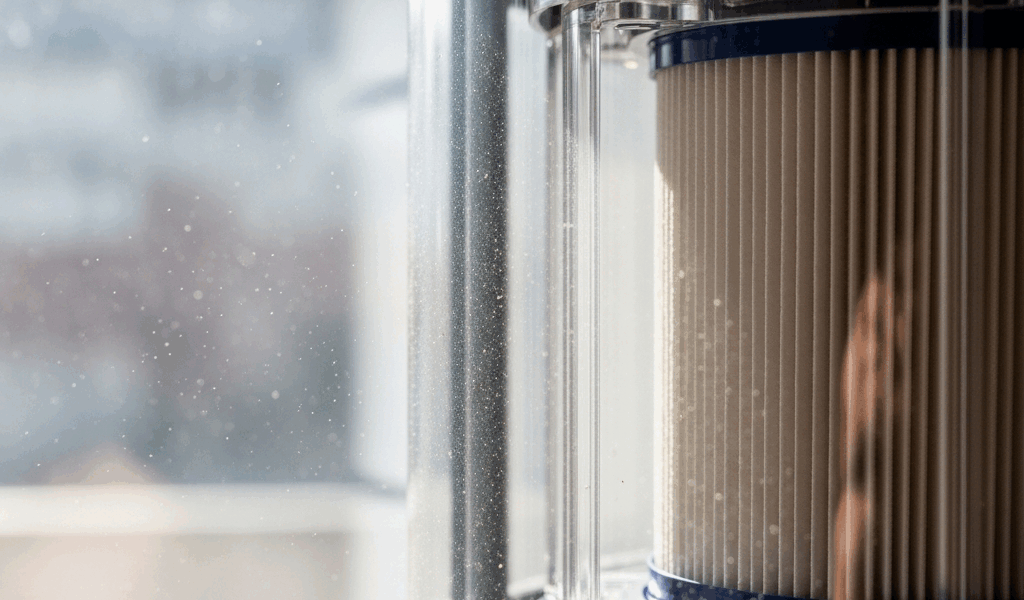
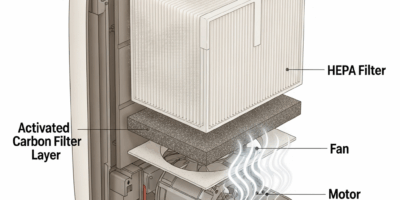
Most purifiers run a two-stage system. The pre-filter — a coarse mesh layer on the outside — catches the big stuff: pet hair, lint, visible clumps of dust. The HEPA filter sitting behind it handles fine particles. But when the pre-filter gets clogged, almost no air reaches the HEPA layer at all. The HEPA stays pristine. The owner assumes the unit is dead. It isn’t.
Locate your pre-filter. On most units, it’s either a mesh cylinder wrapped around the HEPA cartridge or a flat grid on the intake side. Look closely at it — really closely. A visible mat of compressed pet hair and dust is your answer right there.
The fix is straightforward. Tap the pre-filter gently over a trash can to knock loose particles free. Use a soft brush attachment if you have one. For stubborn buildup, a handheld vacuum near — not directly on — the mesh works well to catch debris as it falls. Some pre-filters are fully washable. Check your manual. If yours is, rinse under cool water, squeeze gently, and air-dry it completely before reinstalling. Don’t make my mistake of reinstalling a damp one. Learned that with a Winix 5500-2 back in 2021. The musty smell took a week to clear.
A clogged pre-filter doesn’t just starve the HEPA of air volume. It forces the motor to work harder than it should, shortening the entire unit’s lifespan. Clean yours every two weeks if you have pets or live somewhere dusty. Monthly in cleaner environments.
Fan Speed Settings That Make Your Filter Look Useless
You bought a purifier rated for 400 square feet. Your bedroom is 300 square feet. Makes sense, right? So you set it to the lowest fan speed. Quieter, more energy-efficient, easier to sleep through. And after a month the filter looks pristine.
The filter looks pristine because the unit is barely moving air.
Air purifiers work by cycling room air through the filter multiple times per hour — ideally four to six air changes per hour. At the lowest fan setting in a larger space, you might get one air change per hour. One. That’s not enough to meaningfully clean anything. The filter stays almost white because almost nothing is actually passing through it at meaningful volume.
Medium or high might be the best option here, as effective air purification requires consistent air cycling. That is because the filter media only catches particles that physically contact it — and particles only contact it when air moves through with enough force and frequency. Match your fan speed to your room size and the unit’s rated capacity. Running a purifier on sleep mode 24/7 in a room it’s sized for defeats the entire point. Sleep mode is for sleeping — four or five hours a night, not all day.
When a Clean Filter Means the Unit Has Actually Failed
You’ve verified airflow. Checked placement. Bumped up the fan speed. Cleaned the pre-filter. The main filter is still spotless. Now we look at actual hardware failure.
A dead motor spins the fan slowly or barely at all — even while the display shows normal operation. Hold your hand in front of the intake. You should feel consistent, firm pressure. A failing motor produces weak or wavering airflow that comes and goes. This one requires replacement. The motor assembly on most consumer purifiers isn’t user-serviceable, and sourcing a replacement motor for a $79 unit rarely makes financial sense.
A cracked or improperly seated filter lets air bypass the media entirely. It moves through the unit and out the other side without ever passing through the HEPA layer. Open your unit and look at how the filter cartridge sits in its housing. It should be snug, with zero visible gaps around the edges. Loose or visibly cracked? It’s not filtering anything.
A worn gasket around the filter housing creates the same bypass problem. Air leaks past the seal. You hear the unit running. Air exits the back. None of it passed through the filter. Look for cracks or hardened, brittle rubber around the housing edge — it dries out over time, especially in low-humidity environments.
If any of these apply — a dead motor, a cracked filter, a blown gasket — the unit has reached the end of its useful life. Replacement parts for motors and gaskets often run 40 to 60 percent of the unit’s original purchase price. For most consumer models three or more years old, buying a new unit is the smarter call. So, without further ado, run this full diagnostic before you return anything or spend money on parts. Ninety percent of “broken” purifiers are placed wrong or running settings that make them useless. The other ten percent genuinely failed. Know which one you have.

Stay in the loop
Get the latest northwestcleanair.com updates delivered to your inbox.