Air Purifiers and Water Don’t Mix — Here’s What’s Actually Going On
Air purifier troubleshooting has gotten complicated with all the misinformation flying around. Finding water pooling beneath your unit is alarming — genuinely so. You bought this thing to clean your indoor air, not to create an electrical hazard on your bedroom floor or kitchen tile.
Here’s the short version: a properly working air purifier should never leak water. These devices pull air through filters. That’s it. No spraying, no emitting, no dispensing liquid. So if you’re seeing water, something is wrong — but probably not what you’re imagining.
As someone who panicked over mysterious moisture beneath my bedroom unit for three days straight, I learned everything there is to know about this exact problem. Turned out I’d placed it six inches from a basement window during a humid spring. The water wasn’t coming from the purifier at all. Today, I will share it all with you.
The real culprits fall into two buckets: environmental condensation collecting on or near the unit, or confusion between an air purifier and a humidifier — or some hybrid of both. Either way, it’s fixable. Either way, there’s a clear explanation. And both scenarios are far more common than actual equipment failure.
So, without further ado, let’s dive in.
Is It Actually Your Air Purifier or a Nearby Humidifier
Probably should have opened with this section, honestly. It eliminates half the confusion immediately.
Look at your unit right now. Does it have a water tank, a reservoir, or a fill cap somewhere on top or on the back? If yes — you’ve got a humidifier, an evaporative cooler, or a hybrid humidifier-purifier combo. Those devices hold and dispense water on purpose. Leaks from those follow a completely different troubleshooting path.
But what is a pure air purifier? In essence, it’s a filter-based device that moves air through layers of filtration material — nothing more. But it’s much more than that, which is why the hybrid market gets confusing fast.
If your unit has no water tank and no fill opening anywhere, it is filter-only. It does not produce water. Any liquid beneath it is not originating inside the device.
Common hybrid models include the Levoit LV600S — which has both a humidifier tank and a purifier filter built into one chassis — and various Dreo combo units. Pure air purifiers like the Coway AP-1512HH, the Winix 5500-2, and most Dyson models are filter-only machines. No water involved whatsoever.
Check your manual or the manufacturer’s website if you’re genuinely unsure. Product specs will state clearly whether water dispensing is even a feature.
Condensation Is the Most Likely Culprit — Here’s Why
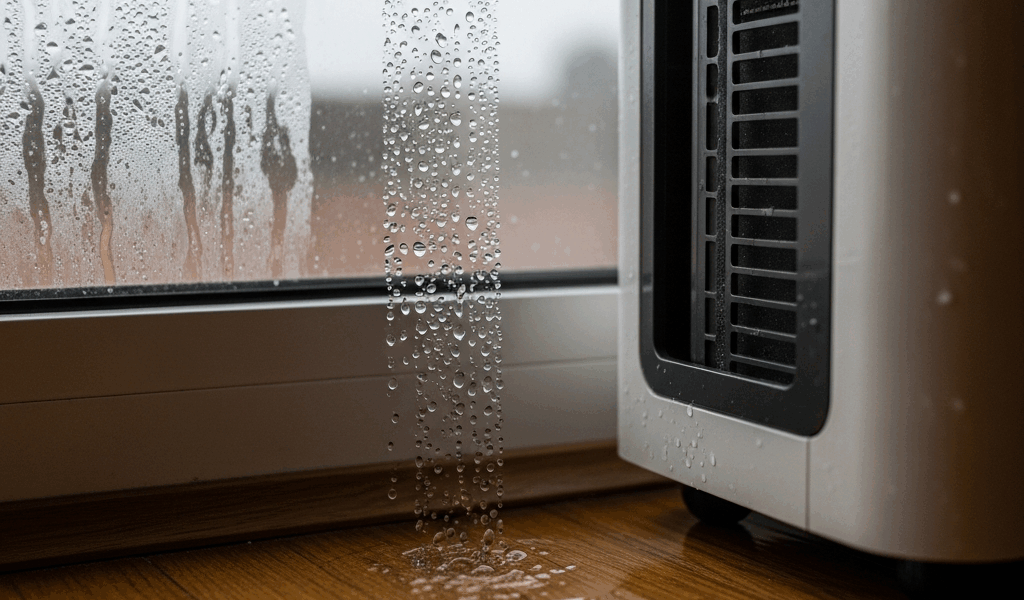
Condensation forms when warm, humid air meets a cold surface. Your air purifier can become exactly that cold surface — especially running inside a high-humidity room or sitting near something creating a temperature imbalance.
Bathrooms are the worst offenders. Shower steam rises, the purifier’s exterior plastic housing cools the surrounding air, moisture condenses on the outside of the unit, and water pools underneath it. Kitchens during cooking behave the same way. So do laundry rooms — honestly, any room with consistent steam or humidity spikes.
Cold air from window units, refrigerators, and AC vents can also trigger condensation when your purifier is placed directly in their path. Near a single-pane window in winter, the temperature differential alone pulls moisture from humid indoor air straight onto the unit’s exterior surface. That’s what was happening in my basement bedroom situation. Moved it three feet. Problem gone.
The fix is pretty straightforward:
- Move the unit at least three feet away from windows — especially old or drafty single-pane ones
- Raise it off the floor using a small shelf or stand — six to twelve inches is sufficient to avoid pooling on tile or carpet
- Don’t position it directly under AC vents or near active heat sources
- Use a dehumidifier in the same room if humidity is consistently pushing past 60 percent
- Make sure the room has adequate air circulation so warm, humid air doesn’t stagnate right around the unit
Fifty percent humidity is roughly where condensation starts becoming more likely in cooler spaces. A cheap digital humidity meter — they run $10 to $15 on Amazon, I use an Inkbird IBS-TH2 — will tell you your room’s actual moisture level. I’m apparently sensitive to humidity and the Inkbird works for me while cheaper no-name sensors never give consistent readings. Don’t make my mistake of skipping that $12 purchase for months.
Target 30 to 50 percent for most indoor spaces. That’s the sweet spot.
Damaged or Wet Filters Can Drip Inside the Unit
This one surprises people. But it’s real — and completely avoidable.
HEPA and carbon filters need occasional washing, especially pre-filters catching large dust particles. The mistake happens at reinstallation: you wash the filter, put it back in while it’s still damp, and moisture pools inside the unit’s housing instead of evaporating through normal airflow. Water sits in the internal chamber. It drips down and out the bottom or through ventilation slots. You see a puddle and assume something broke. You introduced the water yourself.
Check this by pulling your filters out completely. Look inside the unit’s interior plastic housing. Visibly wet? Damp to the touch along the inner walls? Any mustiness or mold smell coming from inside? That’s moisture that has no business being there.
The rule here is non-negotiable: filters must dry for a minimum of 24 hours before going back in. Most people wildly underestimate how long this actually takes. Forty-eight hours is genuinely safer. Hang them vertically in a warm, well-ventilated area — not a bathroom, not a basement.
If your unit’s interior is already wet from this, leave it unplugged with all filters removed for a full 24 hours. Run it for five minutes in an open area before putting it back in your bedroom — just to confirm no water is going to splatter out when airflow kicks back up.
When to Stop Troubleshooting and Contact the Manufacturer
If none of the above explains the water, you may be looking at an internal component failure.
Hybrid humidifier-purifier models with water tanks, pumps, and internal plumbing can develop leaks from hairline cracks, failed seals, or pump malfunctions. Pure air purifiers rarely develop internal leaks unless the housing has physically cracked — say, from being dropped. That was 2021, when I dropped a Winix unit moving apartments. Different problem, obvious cause.
Stop running the unit immediately if water is pooling near the motor, the electrical cord connection, or any internal component you can see. A puddle near power connections is a shock hazard and potentially a fire hazard. Unplug it.
Before calling support, have this ready:
- Your model number — usually on the back label or inside the manual
- The serial number if it’s visible anywhere on the chassis
- A photo of the water and its exact location beneath or around the unit
- How long you’ve owned the device
- Whether it’s still under warranty — check your receipt or the brand’s website directly
- A clear description of when the water first appeared and under what conditions
Most reputable air purifier brands carry 1- to 2-year warranties covering manufacturer defects. Dyson, Coway, Winix, and Levoit all run straightforward warranty claims processes — you’ll likely get a replacement or repair at no cost if the issue is genuinely internal and not something you caused.
Water and electronics don’t belong anywhere near each other. But in most cases, this particular panic ends simply: move the unit, dry out wet filters, or bring the room humidity down. Rarely is it a dead device. Frustrating by a leaking appliance, most people who work through these steps systematically find the answer inside twenty minutes — using nothing more than a flashlight and a cheap humidity meter. This new understanding of condensation’s role eventually evolved into the diagnostic approach air purifier enthusiasts know and rely on today. Start with placement. That’s usually it.



Stay in the loop
Get the latest northwestcleanair.com updates delivered to your inbox.