Why Your Air Purifier Is Not Reducing Odors
Air purifier troubleshooting has gotten complicated with all the conflicting advice flying around. Replace the filter, they say. Clean the unit. Check the settings. Meanwhile your living room still smells exactly like your dog — or last night’s salmon, or whatever drove you to spend real money on this thing in the first place.
As someone who burned three months and two customer service calls on this exact problem, I learned everything there is to know about why air purifiers fail at odor control. Today, I will share it all with you.
My situation: I spent $300 on a well-reviewed unit, ran it nonstop, replaced the filter when they told me to. Nothing changed. Turns out the machine wasn’t broken at all. The problem was something else entirely — something none of the “troubleshooting” articles I found bothered to explain properly.
Your Air Purifier May Not Have the Right Filter for Odors
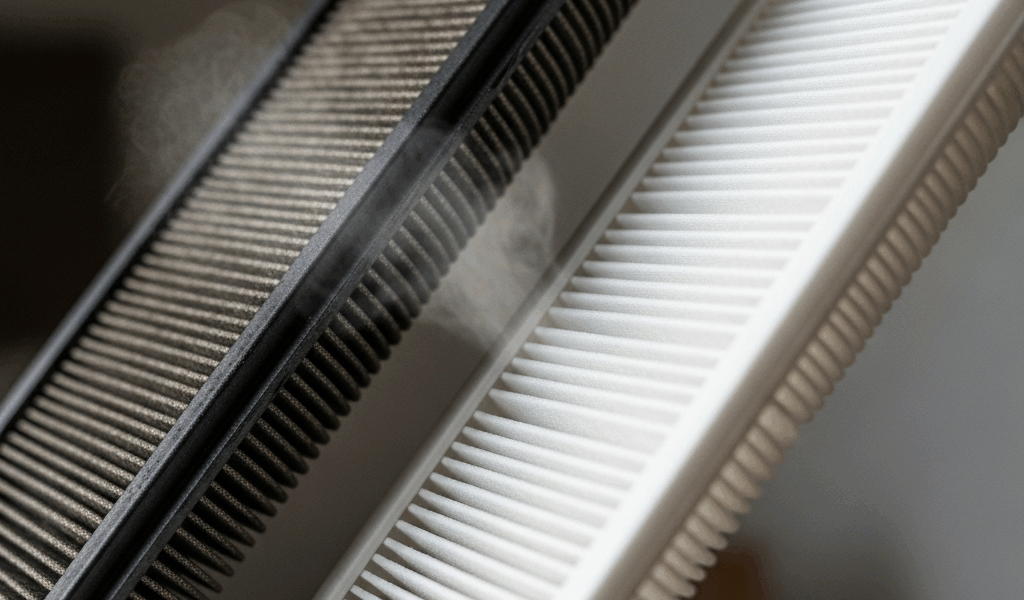
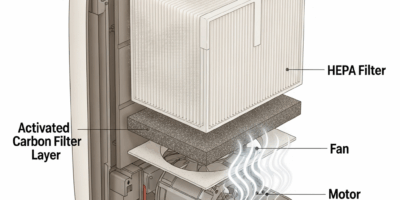
But what is a HEPA filter, really? In essence, it’s a mechanical filter that traps particles — dust, dander, pollen, mold spores — rated to catch 99.97% of particles 0.3 microns or larger. But it’s much more than that. It’s also completely useless against smells.
Odors are gases. Gases float right through HEPA media like it isn’t there. That’s not a flaw — that’s just physics. HEPA was never designed for odor control.
For smells, you need activated carbon. Carbon works through adsorption — odor molecules literally stick to microscopic pores on the carbon surface. It’s the only common filter material that handles gases.
Here’s where it gets frustrating. A lot of budget purifiers include HEPA but skip carbon entirely, or tuck in a thin carbon mesh so shallow it saturates in weeks. You’d never know from the box. The marketing is vague on purpose.
Go check your unit right now. Open the product page. What does it actually say? “HEPA filter” with nothing else listed? That’s your first clue. The machine was never built for odors. Look instead for language like “true HEPA + activated carbon” or “multi-stage filtration with carbon layer.” The carbon should have some weight to it — units that list filter carbon by mass under 0.5 pounds are probably too thin to matter for a full room.
The Coway AP-1512HH runs around $180 and includes a carbon filter actually rated for odors. The Levoit Core 300S sits closer to $100 and pairs HEPA with a genuine carbon pre-filter. Neither unit is pretending to do something its filters can’t do. That’s what makes honest spec sheets endearing to us frustrated shoppers.
No carbon in your current unit? You’ve got two options: find compatible carbon replacement filters for your model, or accept that what you own handles particles — and nothing else.
A Saturated Carbon Filter Stops Working Almost Silently
Probably should have flagged this one earlier, honestly.
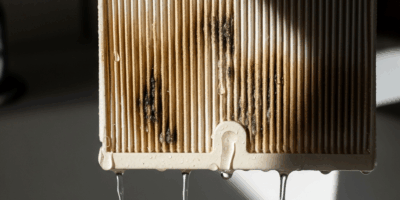
HEPA filters fail visibly. They turn brown and gray. You look at them, think “yep, that’s disgusting,” and swap them out. Simple feedback loop. Carbon filters? They just quietly stop working. No color change. No warning light. The unit hums along looking perfectly functional while odors sail straight through.
What’s happening: every odor molecule the carbon adsorbs fills a microscopic pore. Fill enough pores and the surface is spent. New odor molecules have nowhere to bind. They pass through. The room still smells. You assume the machine is broken.
Manufacturers usually recommend replacing carbon filters every three to six months. Don’t make my mistake — I followed that timeline with two large dogs in the house. Six months was wildly optimistic. My carbon was spent by week ten, maybe earlier. Heavy odor loads burn through carbon fast. Pets, frequent cooking with strong spices, cigarette smoke — any of these can cut your carbon lifespan to four to eight weeks.
When did you last replace yours? If it’s been more than three months and you have pets or cook regularly — replace it now. It will look perfectly fine. Replace it anyway.
Quick diagnostic worth trying: run the purifier in a small bedroom with the door closed for thirty minutes, then walk in and smell. Better? Good — the machine works, but your main room’s carbon is probably saturated. No improvement at all? Keep reading.
Placement and Room Size Can Make Odors Worse
An underpowered unit in a large room is almost theater. It runs. It sounds productive. It changes almost nothing.
Air purifiers work by cycling room air through the filter repeatedly. The relevant metric is ACH — air changes per hour. For real odor control, most recommendations land at four to five ACH, meaning the entire air volume in the room cycles through the filter four to five times every sixty minutes.
Here’s how to actually calculate it: room length × width × height gives you cubic footage. A room that’s 15 feet by 12 feet with 8-foot ceilings holds 1,440 cubic feet. Multiply by five ACH and you need a unit pushing 7,200 cubic feet per hour through its filter. Check your unit’s CADR rating — that number lives on the box or product page. A $99 budget purifier might push 150 CFM. Fine for a 300-square-foot bedroom. Essentially useless in an open living space over 1,000 square feet.
I’m apparently someone who kept their purifier in a corner because it looked less obtrusive there, and the blocked airflow was tanking performance while the open-floor placement never occurred to me. Moving the unit to a central, furniture-free spot made a noticeable difference within a week. Don’t make my mistake.
Central placement. Not a corner. Not under a side table. Not tucked behind a door. Position affects actual performance more than most people expect.
The Odor Source Is Still Active and Overpowering the Unit
So, without further ado, let’s talk about the embarrassingly obvious thing nobody wants to say first.
An air purifier treats air. It doesn’t treat surfaces. If the smell source is still active — pet urine soaked into carpet padding, mold growing behind drywall, a drain that needs cleaning, a trash can sitting there quietly — the unit will run twenty-four hours a day and never catch up.
Think about it this way: mold behind drywall releases spores and gases continuously. The purifier pulls air in, filters out odor molecules, pushes cleaner air back out — and the mold immediately refills the room. It’s an unwinnable race.
The diagnostic is simple. Move the purifier to the kitchen. Does it reduce cooking smells in there? If yes, the machine works fine. Your main room has an active source — carpet, upholstery, a moisture problem, something structural — that needs direct treatment, not filtered air cycling over it forever.
If the unit helps in some rooms and not others, the problem room has an unaddressed source. If it helps nowhere, go back up and recheck filter type and carbon age.
Quick Fixes to Try Before Buying a New Unit
Start here. In order. Don’t skip ahead.
- Verify the filter type. Does your unit actually have activated carbon? Pull up the product page right now. No carbon listed anywhere? You need either a compatible carbon replacement filter or a different machine entirely.
- Replace the carbon filter. Even if it looks completely clean — especially if it’s been more than three months and you have pets or cook frequently. Replacement filters run $20–$80 depending on the model. Worth it before assuming the unit is garbage.
- Reposition the unit. Central, open floor placement only. Not corners, not furniture-blocked spots, not tucked away for aesthetics. Free fix, immediate impact.
- Check room size against actual unit capacity. Calculate the CFM you need for your room at five ACH. If your unit falls short, odor control will be slow at best — you either upgrade or manage expectations.
- Hunt the odor source. Run the purifier in a different room. Works there? Your main room has an active source that needs direct treatment — cleaning, ventilation, moisture control, whatever applies.
Most odor failures trace back to a filter issue or a placement problem. Not a defective machine. Not wasted money. Work through this list and there’s a good chance you solve it today — without buying anything new.

Stay in the loop
Get the latest northwestcleanair.com updates delivered to your inbox.