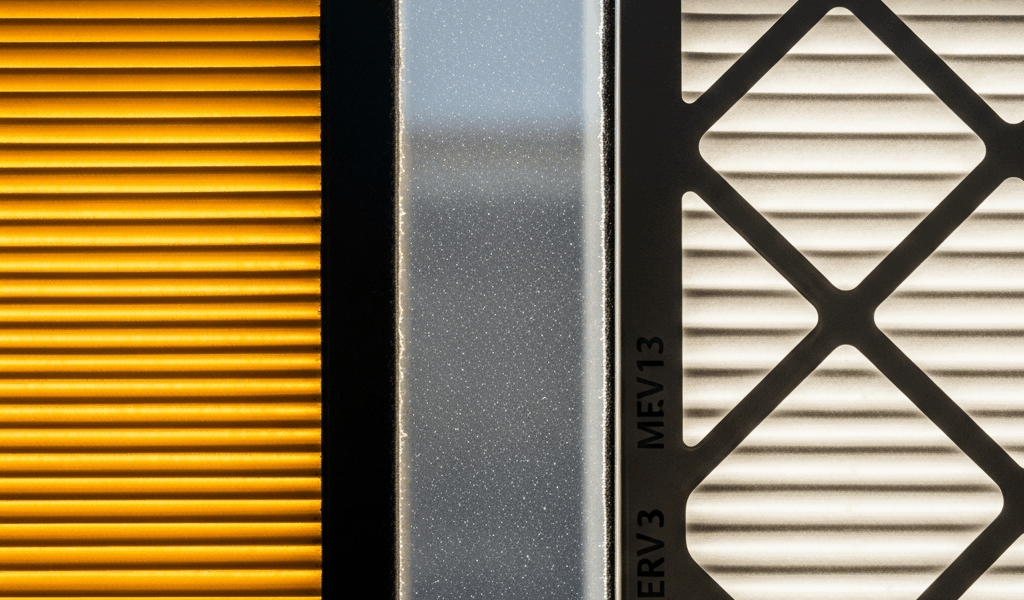
MERV 13 vs HEPA — Which Filter Actually Cleans Your Air Better
Air filtration has gotten complicated with all the conflicting advice flying around. As someone who spent the better part of last spring deep in homeowner forums after my daughter’s asthma flared up during wildfire season, I learned everything there is to know about indoor air filtration — including the one mistake that keeps tripping people up. These two filters don’t compete with each other. They live in completely different parts of your home. Some people were jamming high-MERV filters into HVAC systems that couldn’t handle them. Others were buying tiny HEPA purifiers and expecting them to scrub the air in a 2,000 square foot open floor plan. Neither works. So let’s actually break this down.
This article includes affiliate links. We may earn a commission at no extra cost to you.
What MERV 13 Is and How It Works
But what is MERV 13? In essence, it’s a standardized rating — Minimum Efficiency Reporting Value — developed by ASHRAE, the American Society of Heating, Refrigerating and Air-Conditioning Engineers. But it’s much more than that. It’s a whole sliding scale, running from 1 to 16 for residential and commercial use, telling you how fine a filter’s mesh actually is.
A MERV 13 filter captures roughly 90 percent of particles in the 3 to 10 micron range — dust mites, mold spores, pet dander, pollen, a fair chunk of bacteria. It also snags around 50 percent of particles in the 1 to 3 micron range, which is where smoke particles and fine dust start showing up. The thing slots directly into your existing HVAC system. Same slot your current filter uses right now. No new equipment, no installation fee — pull out the old one, slide in the MERV 13, done.
That “working harder” part matters, though. MERV 13 filters are denser than the cheap fiberglass ones most people use — MERV 1 to 4, honestly useless for air quality purposes. That density creates resistance, what HVAC people call static pressure. Older systems, anything built before roughly 2010, often have blower motors that weren’t designed for it. Forcing a MERV 13 into an old system can strain the motor, choke airflow to your vents, and in bad cases, crack the heat exchanger from overheating.
Check your HVAC manual before buying — or just call your technician. Many modern systems, like the Carrier Infinity series or Trane XR units, handle MERV 11 through 13 without issue. Older system? MERV 11 is usually the smart compromise. Meaningful filtration, without hammering the blower motor.
Cost and Replacement Schedule
MERV 13 filters run $20 to $50 depending on size and brand. The Nordic Pure MERV 13 in a 16x25x1 size goes for about $22 on Amazon. The Filtrete 1500 MPR — roughly equivalent to MERV 12 to 13 depending on which lab tested it — runs around $28 for the same size. Replace them every 60 to 90 days under normal use, every 30 days if you have pets or live somewhere with heavy particulates. Annual cost for a single-system home lands somewhere between $100 and $250. That’s it. No new hardware whatsoever.
What HEPA Is and Where It Goes
But what is HEPA? In essence, it stands for High Efficiency Particulate Air — a filter standard that captures 99.97 percent of particles at 0.3 microns, the most penetrating particle size, where filtration is actually hardest. But it’s much more than just a number. Below and above that size, capture rates go up. The 0.3 micron figure is the floor, not the ceiling.
Here’s what almost nobody explains clearly: you cannot put a HEPA filter in a residential HVAC system. The airflow resistance is simply too high. Residential blower motors can’t push enough air through true HEPA media to condition an entire house — industrial air handlers can, but not the unit in your basement or attic. HEPA filters belong in standalone purifiers. Units like the Coway AP-1512HH, the Winix 5500-2, the Blueair Blue Pure 211+, or the IQAir HealthPro Plus at the high end.
Standalone HEPA purifiers pull room air through a fan, pass it through the HEPA media — usually with a pre-filter and carbon layer for odors — and push clean air back out. They work exceptionally well. But only for the room or zone they’re sized for. A purifier rated for 360 square feet does nothing meaningful for the bedroom down the hall. That’s what makes HEPA purifiers both impressive and limited to us everyday homeowners trying to clean the whole house.
Cost of Units and Replacement Filters
Entry-level HEPA purifiers start around $80 to $100. The Levoit Core 300 is a popular choice in that range. Mid-range units like the Coway AP-1512HH run $120 to $150 and cover up to 360 square feet. The Blueair 211+ covers up to 540 square feet and costs around $300. The IQAir HealthPro Plus — the unit hospitals and research facilities actually use — runs about $900.
Replacement HEPA filters cost $30 to $80 per filter, replaced every 6 to 12 months. Heavy use or wildfire season burns through them faster. Don’t make my mistake — I got stunned by the IQAir replacement filter cost after already falling in love with the unit. Check filter prices before you commit to any purifier.
Which One Do You Actually Need
Probably should have opened with this section, honestly. The real question isn’t which filter is better — it’s what problem you’re trying to solve and where.
Allergies and Pet Dander
Either approach works for common allergens. Pet dander, pollen, and dust mite particles are large enough that MERV 13 in your HVAC catches a solid portion as air cycles through — and the advantage there is whole-house coverage. Every room benefits as long as the system runs. A HEPA purifier sitting in the living room does nothing for your bedroom.
That said, severe allergies or a specific room trigger? A HEPA purifier in that space gives you a higher filtration ceiling. Running both together is the strongest setup — MERV 13 handles the whole-house baseline load, HEPA purifier covers the room where you spend the most time.
Wildfire Smoke
Wildfire smoke is brutal — full stop. The fine particles, PM2.5 and smaller, are genuinely dangerous, and they’re small enough that MERV 13 only captures a fraction of them. HEPA is substantially more effective here. Frustrated by an air quality index sitting at 180 outside two summers ago with nothing in the house to deal with it, I drove to a local Best Buy and grabbed a Winix 5500-2 for $179. Ran it in the bedroom with windows sealed and the improvement was noticeable within an hour.
For wildfire smoke, a HEPA purifier is your primary tool. Pair it with MERV 13 in the HVAC, seal gaps around windows and doors, and run your system in recirculation mode if it has one.
General Air Quality Improvement
No specific health crisis — just want cleaner air throughout the house? Upgrading to MERV 13 in your HVAC is the highest-leverage move you can make. Cheap, passive, no new equipment, works every time your system runs. Most American homes still use MERV 1 to 4 filters. Jumping to MERV 13 is a dramatic improvement for $25 and five minutes of your time.
Common Mistakes When Buying Filters
Forcing a High-MERV Filter Into an Old System
This is the big one. People read that MERV 13 is good and immediately swap it in without checking compatibility. An older single-speed blower motor running against high static pressure will overheat, wear out faster, or gut your airflow entirely. Rooms stop heating and cooling properly, energy bills climb. Check your system specs first. Call your HVAC tech if you’re unsure — most will tell you over the phone in two minutes what the system can handle.
Buying a HEPA Purifier Too Small for the Room
Room coverage ratings are calculated under ideal conditions — an empty room, standard 8-foot ceilings. Your 400 square foot room with 10-foot ceilings and furniture everywhere needs more than a purifier rated for exactly 400 square feet. Buy for a larger coverage area than your actual room, or look for higher CADR ratings — more air cycles per hour means better real-world performance in imperfect spaces.
Not Checking CADR Ratings
CADR — Clean Air Delivery Rate — measures how many cubic feet of filtered air a unit delivers per minute, rated separately for smoke, dust, and pollen. Higher CADR means faster, more thorough cleaning. The Association of Home Appliance Manufacturers certifies these through independent testing — look for the AHAM Verified mark. A smoke CADR of 200 or above is a solid target for a medium bedroom. Anything under 100 is underwhelming for regular use. Marketing claims like “covers 500 square feet” are meaningless without a CADR number behind them.
Skipping Filter Replacement
A clogged MERV 13 actively chokes your HVAC airflow. A clogged HEPA filter in a standalone unit can release trapped particles back into the room — the opposite of what you bought it for. Set a calendar reminder. Write the replacement date on the filter with a Sharpie when you install it. The Filtrete app handles reminders automatically if you’re using their filters. However you manage it, don’t let it go six months without a check.
MERV 13 and HEPA both genuinely improve indoor air quality — they’re just tools for different jobs. MERV 13 is your whole-house baseline, passive and affordable, built into equipment you already own. HEPA purifiers are targeted, room-specific, high-efficiency tools for when you need something stronger or more focused. The homeowners with the best air quality use both. Start with MERV 13 in your HVAC if you’re not already there, then add a HEPA purifier in the bedroom or wherever you spend the most time. That combination covers the widest range of particles, at the widest range of conditions, without requiring you to spend a fortune to make it work.
Filtration is only one layer of asthma control. Our indoor asthma trigger guide explains source control, humidity, smoke, mold, pets and action-plan coordination.


Stay in the loop
Get the latest northwestcleanair.com updates delivered to your inbox.