First — Is the Hum Normal or a Warning Sign
Air purifier noise has gotten complicated with all the conflicting advice flying around. Some people panic the moment their unit makes a sound. Others ignore noises they genuinely shouldn’t. Here’s what actually matters: almost every air purifier hums. It’s the motor and fan doing their job. The real question isn’t whether your unit makes noise — it’s whether what you’re hearing now sounds different from what you heard the day you unboxed it.
As someone who’s owned three air purifiers over the past five years, I learned everything there is to know about this specific problem. Today, I’ll share it all with you. My Levoit Core 300 runs at a steady 24dB on low speed and climbs to around 45dB on high. That’s normal. A sudden jump in volume? A pitch change? A grinding or rattling sound underneath the usual hum? That’s not normal. That’s a signal.
Steady, consistent hum at higher fan speeds just means your unit is working harder. I run mine on high constantly during wildfire season here in the Pacific Northwest — the motor pushes more air through the filter, the sound goes up. Expected. Fine.
A problem hum is different. It arrives suddenly. It’s louder than before. Something about it sounds wrong — metallic, grinding, or like something’s vibrating loose inside the housing. That’s when you investigate.
So, without further ado, let’s dive in. We’ll start with the most common culprit — something you can check in under two minutes — then work through the other causes in order of how often they actually happen.
The Most Common Cause — A Dirty or Overloaded Filter
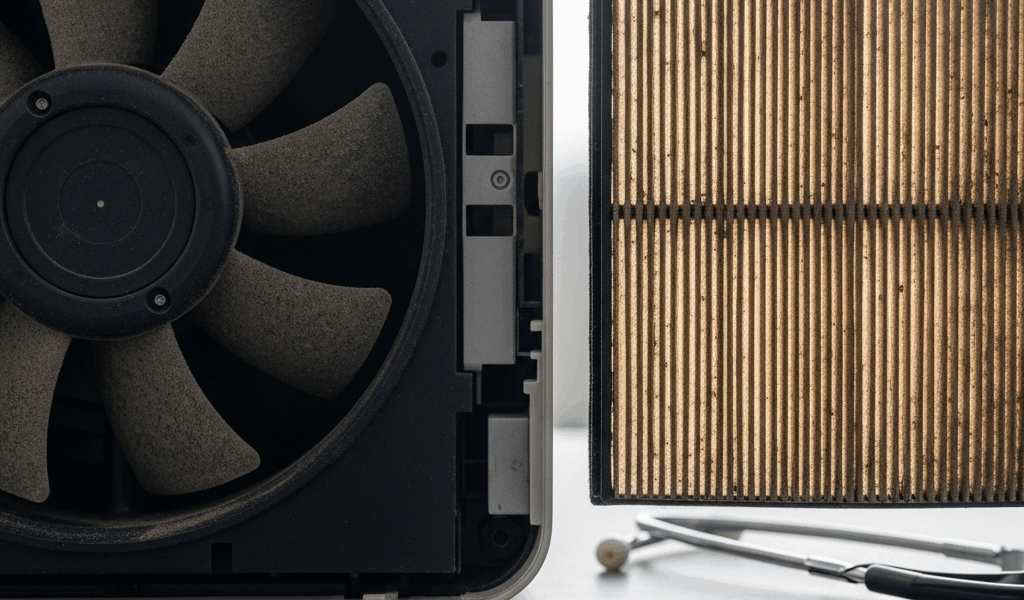
Clogged filters cause roughly 80% of the noise complaints I’ve seen across forums and product reviews. A dirty filter restricts airflow. The motor compensates by spinning faster. Faster spin means higher pitch, more volume, and a whole lot of unnecessary worry.
This happens faster than most people expect — especially out here in the PNW. During wildfire season, HEPA filters can load up with smoke particulates in three to four weeks instead of the usual three to four months. Frustrated by a suddenly loud Coway Airmega during the 2021 smoke events, I tore the thing apart looking for broken parts using a flashlight and about forty minutes of my evening. Nothing was broken. The filter was just completely saturated — grey-black and stiff as cardboard. That was 25 days after I’d installed a fresh one.
Don’t make my mistake. Check the filter first.
Turn the unit on high. Hold your hand near the intake grille — usually the back or bottom — and listen. A clean filter pulls air with a smooth, open sound. A clogged filter forces air through a compressed surface, and you’ll hear it strain. Remove your hand. If the pitch drops noticeably, the filter is your problem.
Pull the filter out and look at it. New filters are white or off-white. Dirty ones run grey, brown, or flat black depending on your air quality. Press it gently with one finger. A healthy filter springs back. A saturated filter feels dense and stays compressed.
If it looks grey or feels wrong, replace it. Most HEPA filters run $20 to $60 depending on brand. The Levoit Core 300 replacement pack is around $30. Coway filters are closer to $50. Worth every dollar.
Even if the filter looks only moderately dirty, replace it anyway — at least if it hasn’t been swapped out in six months or longer and the noise started suddenly. Partial blockage doesn’t always show up visually. The motor still feels it.
Loose Parts and Rattling — How to Find the Culprit
But what is a rattle, exactly? In essence, it’s vibration from one component making contact with another. But it’s much more than that — it’s also your fastest clue that nothing is actually broken, because rattles are almost always fixable without ordering a single replacement part.
Start with the filter frame. On most units, the filter slides or clips into a housing. If it’s even slightly unseated, it vibrates during operation — constantly, rhythmically, maddeningly. Pop the cover, pull the filter, reinstall it deliberately. Feel for the click or lock. Replace the cover. Run it. Problem often solved right there.
Next, check the front grille or access panel. On Levoit Core series units specifically, there’s a removable front panel that snaps into place at four corners. Miss even one corner and you get a rattle. Press firmly around all edges until each point locks.
Then reach gently into the intake and feel around for debris. Pet hair, dust clumps, small objects that fell through the grille. Even a single long hair caught on a fan blade creates a distinct ticking or grinding rattle — surprisingly loud for something so small.
Here’s a diagnostic trick I actually use: run the unit and gently press different panels while it’s operating. Press the front. The side. The back. When you press the vibrating component, the rattle either quiets down or gets worse. That tells you exactly where to focus. Once you’ve located it, you tighten it, reseat it, or clean it. Simple.
Fan Blade and Motor Issues — What the Sounds Mean
If no loose panel or misseated filter explains the noise, the issue is probably inside the motor assembly itself. Two distinct scenarios here — and they sound different enough that you can diagnose by ear.
First scenario: grinding or whining that gets progressively worse over weeks or months. That’s motor bearing wear. The bearings are small mechanical components that let the shaft spin smoothly — when they degrade, friction builds and the pitch climbs steadily. I’m apparently the kind of person who tries to repair budget purifiers instead of replacing them, and my $79 Levoit taught me that lesson the hard way. Two hours. No fix. On units under $100, bearing replacement costs more than a new unit. Probably end-of-life territory. If the unit is 3+ years old, start shopping.
Second scenario: a wobbling or periodic tapping that appeared suddenly. This usually means a fan blade is loose or slightly bent — often from a piece of debris that made contact during operation. Handy people can sometimes access the motor housing and check blade alignment directly. On most consumer models, that means partial disassembly. If you’re not comfortable doing that, it’s a technician job — and honestly, on budget units, the labor cost rarely makes financial sense.
The honest truth: consumer air purifier motors aren’t designed for home repair. Opening the housing risks additional damage and almost certainly voids whatever warranty remains. I’ve been down that road. It doesn’t end well.
Placement Fixes That Reduce Noise Right Now
Probably should have opened with this section, honestly — because placement fixes are free, take five minutes, and sometimes eliminate noise that has nothing to do with the unit itself.
Hard floors amplify vibration. Tile and hardwood act like speaker cones. Place your purifier on tile, run it. Move it to carpet, run it again. The difference is often dramatic — sometimes night and day. If you have hardwood or tile floors, put the unit on a rubber anti-vibration mat — around $15 on Amazon — or even a folded bath towel. That alone can cut perceived noise by 3 to 5 decibels. Real, measurable difference.
Also check wall distance. Units placed flush against a wall or tucked into a corner recirculate their own exhaust, which forces the motor to work harder and run louder. Move it at least 12 inches from walls on the intake side. Some manufacturers specify 3 feet for optimal airflow — and they’re not wrong.
Five-minute placement check:
- Move the unit to open floor space, away from walls on all sides.
- Place it on a rubber mat or folded towel.
- Run it at the same speed you’ve been using and listen for 30 seconds.
If the noise dropped, you’ve solved it. If not — that’s what makes filter inspection so endearing to us air purifier troubleshooters — it’s always the next logical step, and it costs almost nothing to check.


Stay in the loop
Get the latest northwestcleanair.com updates delivered to your inbox.