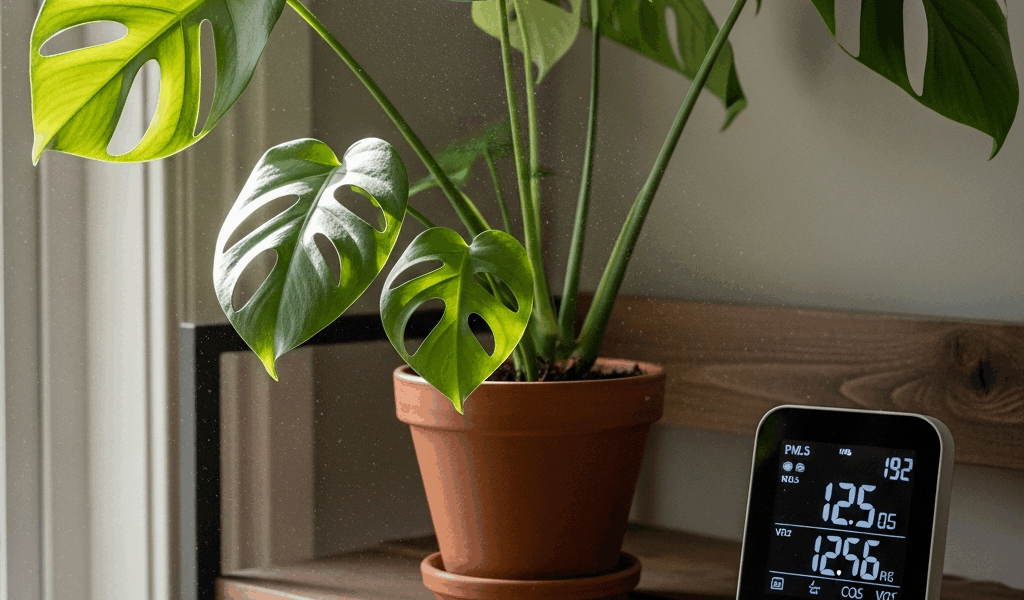
Houseplants and Indoor Air Quality Has Gotten Complicated With All the NASA Mythology Flying Around
I have roughly forty houseplants crammed into my apartment. Pothos trailing down the bookshelf. A monstera taking over the corner. A fiddle leaf fig that barely survived its first winter — honestly, I’m still not sure how. When I started collecting them about five years ago, I was convinced they were doing serious, measurable work on my air quality. The NASA study seemed to back that up.
Everyone cites it. Indoor air is five times more polluted than outdoor air, the reasoning goes. Plants are nature’s purifiers. So I bought more plants. Read more articles. The whole internet agreed, and I had no reason to push back.
Then I actually looked at what the NASA study measured. And whether any of it applied to a real apartment with real air movement and real people walking in and out. The answer surprised me, then frustrated me, then made me rethink why I keep buying plants anyway.
But what is the NASA plant study, really? In essence, it’s a 1989 laboratory experiment measuring plant performance under sealed, artificial conditions. But it’s much more than that — it became the founding document of a billion-dollar wellness mythology. And the actual science underneath it is far more interesting than anything the myth delivers.
What the NASA Study Actually Found
Frustrated by the lack of air-quality solutions for long-term space habitation, researcher B.C. Wolverton published work for NASA in 1989 using sealed test chambers roughly 30 cubic feet in volume — picture a very small closet — pumped with specific volatile organic compounds. Formaldehyde. Benzene. Trichloroethylene. He measured how well various houseplants removed those chemicals over time.
The results were clear. Certain plants removed certain chemicals. Pothos handled formaldehyde. Peace lilies absorbed benzene and trichloroethylene. Spider plants managed multiple VOCs simultaneously.
The data was real. The methodology was sound.
The leap from laboratory chamber to living room was not.
Those sealed chambers had no air exchange. Nothing cycling in or out. The plant sat with a fixed quantity of pollutants in a closed system and worked against a static problem. That design measures theoretical potential — what a plant could do if everything else remained frozen and no outside air ever entered. Useful for understanding mechanism. Not useful for predicting anything about an actual building with actual people in it.
Probably should have opened with this section, honestly. Understanding the experimental design would have saved me from buying that fourth pothos.
Real homes breathe constantly. Heating systems cycle. Doors open. Exhaust fans run. Depending on your setup, the entire air volume of your home gets replaced multiple times every single day. That assumption — the one the chamber study removed entirely — turns out to matter enormously.
The marketing angle was irresistible, though. Home improvement retailers picked it up fast. Interior designers cited it. By the 2010s, every wellness blog was treating the NASA study like settled gospel. NASA! Government scientists! Plants clean your air! I fell for it the same way everyone else did.
The Gap Between the Study and Its Use
Wolverton himself wasn’t claiming his findings applied directly to homes. The paper was exploratory — interesting preliminary work, not a design specification for household air purification. That nuance evaporated quickly.
What followed was a cascade of misquotation. Each article simplified. Each blog post stripped more context. Within a few years, the standard claim became “NASA scientists say houseplants purify air” — no chamber size, no sealed conditions, no scaling problem mentioned anywhere.
One paper showed a pothos removing roughly 3.5 micrograms of formaldehyde per minute under those laboratory conditions. That sounds scientific. That sounds real and specific. Most people reading it never asked what 3.5 micrograms per minute means against an actual room with actual air movement happening constantly. I didn’t ask. I just bought the pothos.
Why It Does Not Apply to Your Home
The correction came in 2019. Researchers Cummings and Waring published a meta-analysis in Building and Environment journal — they pulled the NASA data and similar studies, then ran the actual math on what meaningful air quality improvement would require in a real home.
The number was genuinely shocking. Ten to a thousand plants per square meter of floor space.
Your bedroom is probably around 150 square feet. That’s roughly 14 square meters. Using the low-end estimate, you’d need 140 pothos plants in your bedroom alone — just to approach the air-cleaning rate of a standard HVAC system doing its normal job. That’s 140 plants. In one room.
A typical home cycles through 0.5 to 2 complete air replacements per hour depending on how sealed the building is and how the ventilation operates. Air moves fast. A single pothos has maybe 50 to 100 square inches of leaf surface, depending on size. Your bedroom walls alone are 1,000-plus square feet. The math doesn’t work in the plant’s favor — and it’s not the plant’s fault. It’s physics.
Cummings and Waring ran the numbers carefully, with peak growing conditions, maximum leaf surface, and favorable species selection. The removal rate still doesn’t scale to meaningful air quality change. Air moves too fast. Plants work too slowly. That’s the whole story.
The Air Exchange Problem Explained Simply
Think of your home like a bucket. Pollutants pour in constantly — cooking creates particulates, furniture off-gasses formaldehyde, cleaning products release VOCs. The bucket keeps filling.
The only way to meaningfully empty it is to swap out the contents with fresh air or run the air through filtration that actually captures what’s in it.
A plant in the corner is like putting a sponge in the bucket. It absorbs something. Not much. Not fast enough to matter when the bucket keeps getting filled and swapped out multiple times per day regardless. Remove the sealed-chamber assumption and the sponge becomes cosmetic.
I tested this casually in my own apartment. I have a formaldehyde monitor — a Temtop M2000 5th Gen, roughly $60 online, nothing fancy. My apartment sits around 0.05 PPM formaldehyde on average, which is well within safe ranges. Opening a window for ten minutes dropped it further. My forty plants changed it imperceptibly. Then I ran my HEPA filter instead. Dramatic difference. Measurable drop within an hour and sustained improvement while it ran continuously. One system works. One does not.
What Houseplants Actually Do for You
This is where I almost scrapped the entire article. Because houseplants are still worth having. Just not for air purification.
The mental health benefits are real and documented. Green plants in living spaces correlate with reduced stress, improved mood, and better cognitive function — not because of air chemistry, but because humans respond to living things in ways we respond to almost nothing else. That’s what makes houseplants endearing to us plant people. It isn’t the filtration claims. It was never the filtration claims.
I can feel the difference between my apartment with plants and without them. During one pandemic winter, I pulled most of them out for a month — I’d convinced myself it wasn’t worth the effort. The space felt emptier. Not cleaner. Emptier. I brought them back within six weeks.
Humidity is another real benefit. Plants release water vapor through transpiration, and in dry climates or during winter heating season, that actually matters. A moderately watered plant can increase relative humidity by 2 to 5 percentage points in a room. If you live somewhere that drops to 20% humidity in January, that’s genuinely helpful — subtle, not transformative, but real.
The aesthetic and biophilic value is real too. Probably worth more than both the humidity and mood benefits combined, if I’m being honest. A living, growing thing in your space does something inert objects cannot replicate. Air purification is not real. That’s the correction. Everything else stands.
Keeping Them Anyway
I keep my forty plants for the real reasons, not the marketing ones. They make the space feel alive. They pull moisture into dry winter air. They do something to my brain that responds to growth and care in a way that a nice lamp simply doesn’t.
That’s enough. It should be enough. We don’t need houseplants to be medical devices to justify keeping them — so why did we let the industry convince us they were?
The misconception persists because it serves everyone selling something. Plant retailers move more product. Health content creators get more engagement. The myth was too useful to die despite being demonstrably wrong. This new idea — plants as air purifiers — took off several years after the 1989 study and eventually evolved into the wellness gospel enthusiasts know and repeat today.
What Actually Cleans Your Indoor Air
So, without further ado, let’s dive in — because if air quality improvement is your actual goal, here’s what the mechanisms that genuinely work look like.
HEPA Filtration
HEPA stands for High-Efficiency Particulate Air. These filters capture particles 0.3 microns and larger at 99.97% efficiency. They work. I’m apparently a Coway person — I run an Airmega 300 in my living room, roughly $300 new — and it works for me while the cheaper knockoffs I tried before never really did. Don’t make my mistake of spending $40 on a no-name unit first.
Particulates drop. Dust accumulates less visibly on surfaces. Breathing feels noticeably clearer during high-pollen seasons. HEPA doesn’t remove gases or VOCs — it captures particles. Pollen, dust mites, pet dander, cooking smoke, fine particulates from outdoor pollution. For most people in most homes, these are the actual air quality problems anyway.
A HEPA filter running continuously in a bedroom will outperform any plant combination you could reasonably fit in the room. By a wide margin.
MERV 13 HVAC Filters
While you won’t need an entire air quality system overhaul, you will need a handful of better filters if you have central air. Most homes run MERV 8 or MERV 11 — these catch larger particles and call it done. MERV 13 filters catch smaller particles, down to 0.3 microns in many cases.
First, you should check your furnace model’s filter slot size — at least if you want to avoid buying three wrong sizes like I did. Then upgrade. Costs $15 to $30 per filter, replace every three months. Your air cycles through this filter 6 to 24 times daily. It matters more than anything sitting in the room itself.
Source Control
Stop the pollution at the source. Unglamorous. Works.
Use exhaust fans when cooking. Open windows on cool days. Buy low-VOC paints and finishes — Benjamin Moore Natura runs about $65 a gallon and is genuinely low-emission, not just marketed that way. Choose furniture made with less formaldehyde-based adhesives. Store chemicals in the garage. Don’t smoke indoors.
I switched to natural cleaning products five years ago — not because I trusted the marketing claims about safety, but because I wanted to reduce the chemical smell in a small apartment. My baseline VOC reading dropped noticeably within a few months. Cost about the same as conventional products. That was a genuinely easy win.
Ventilation
Open your windows. Seriously. Outdoor air is cleaner than indoor air, despite what wellness marketing implies.
On cool mornings, or any reasonable fall or spring day, crack the windows for 15 minutes. Air exchange rate spikes. Stale air leaves. Fresh air enters. Moisture and heat buildup dissipates. This is free. It requires nothing. Most people ignore it in favor of sealed homes and expensive passive solutions.
Ventilation might be the best option, as indoor air quality requires active management. That is because air doesn’t purify itself — it needs somewhere to go, and outside is the obvious answer that’s somehow the least discussed one.
Gas Phase Filtration
If you genuinely have elevated VOC levels from specific sources — living near industrial areas, new construction off-gassing, specific material problems — activated carbon filters remove gases where HEPA cannot. The Winix 5500-2 runs about $180 and combines both HEPA and activated carbon in one unit. Not necessary for most people. Worth knowing exists.
The Honest Takeaway
Houseplants don’t clean your indoor air in any meaningful way. The NASA study measured potential under sealed conditions. Real homes have air exchange that overwhelms plant filtration completely — and the 2019 meta-analysis put specific numbers to just how overwhelming that gap is.
This doesn’t mean get rid of your plants. It means stop expecting them to do work they were never designed for and aren’t capable of delivering.
Buy them because they look good. Because caring for something gives you a reason to check in on it every few days. Because green things make spaces feel alive in ways that expensive furniture cannot. Because they bump your humidity up a few points in a dry January. Because your brain responds to living organisms in ways science is only beginning to quantify.
Don’t buy them as a substitute for ventilation, filtration, or source control. Don’t make my mistake — I spent years thinking forty plants were doing serious environmental work when a single $30 MERV 13 filter was the upgrade I actually needed.
The myth was appealing. Passive, natural, NASA-backed air cleaning — it was too good to be true because it was. The actual science is less marketable and considerably more honest. Air quality requires active management. Plants are companions, not devices. I’m keeping my forty. I’m also running my HEPA filter and opening my windows on cool mornings. That combination actually works.


Stay in the loop
Get the latest northwestcleanair.com updates delivered to your inbox.