Why Your Air Purifier Fan Runs But Air Smells Stale
Air purifiers have gotten complicated with all the marketing noise flying around. “True HEPA.” “Smart sensors.” “Auto mode.” You buy the thing, plug it in, and assume it’s working. The fan spins. The light stays green. And your bedroom still smells like a campfire or a dog kennel or just — stale, inexplicably stale.
As someone who wasted a month breathing questionable air in a $300 Levoit Core 300S-equipped bedroom, I learned everything there is to know about why these machines fail silently. Today, I will share it all with you.
The short version: it’s almost never the motor. The gap between a running purifier and an effective one is wider than most manufacturers want you to know — and it comes down to a handful of fixable problems.
The Filter Is Older Than You Think
Here’s what the manufacturer won’t say loudly: that replacement indicator light? It’s a timer. That’s it. It assumes average air quality, a standard-sized room, and a normal dust load. It’s guessing — and often guessing wrong.
But what is a saturated carbon filter? In essence, it’s a filter that looks fine but can’t actually do its job anymore. But it’s much more than just an inconvenience — it’s the reason your $300 machine is basically a fan.
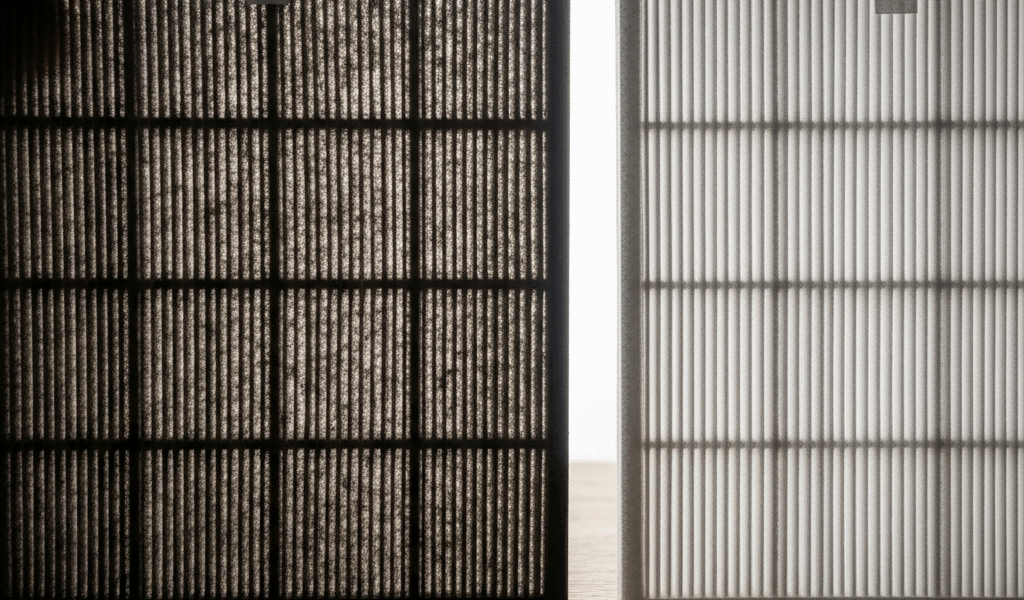
Activated carbon layers are the sneaky culprit here. They trap odors and chemical compounds from smoke, cooking, off-gassing furniture. They saturate quietly. Unlike HEPA layers, there’s no visible gray crust forming on the carbon side. The filter looks nearly clean while being completely spent.
I figured this out the hard way. My Levoit’s indicator said 60% filter life remaining. Out of curiosity, I held the outlet directly to my nose while the unit ran at max speed. The air coming out smelled exactly like the air already in the room. Stale. Faintly smoky. Zero improvement. That was month two of ownership.
Don’t make my mistake. Do the sniff test today — before you assume the machine is working.
Try this right now: Open the filter access panel. Pull the filter out carefully. Hold it up to natural light and look at the pleats. Dark gray or brown instead of white means the HEPA layer is saturated. Flip it over and smell the carbon side — the black or darker gray panel. If it smells like whatever’s bothering you in the room (smoke, mustiness, pet odor), the carbon is done. Finished. Replace it regardless of what the indicator says.
During wildfire season, plan on replacing every 30 to 45 days if the unit runs continuously. The manufacturer’s timeline assumes you’re not living downwind from three active fires burning through August.
Your Pre-Filter Is Choking the Machine
Probably should have opened with this section, honestly. The pre-filter is the reason most air purifiers underperform, and almost nobody knows to clean it.
The pre-filter is the first layer of defense — usually a coarse foam or mesh panel that catches large particles like dust, pet hair, and lint before they reach the HEPA filter. It sits right at the intake and extends HEPA life by blocking the big stuff early. That sounds great until you realize it clogs fast, and a clogged pre-filter starves the entire machine of airflow.
Think of it like a shop vac with a sock stuffed over the intake. Technically running. Technically useless.
Same principle here. A blocked pre-filter can cut your unit’s actual airflow down to 40% of what it should be moving — sometimes less. The machine runs all night. It moves air. Just not nearly enough air, and never enough to actually cycle your room the way it’s supposed to.
Most units include a washable pre-filter — usually a gray or white foam panel on the intake face, sometimes a mesh cage you can unclip in about four seconds. Open the access panel and look. If you’ve never cleaned it, it’s probably gray or tan with a clearly visible dust layer. That’s your problem right there.
How to clean it: Remove the pre-filter entirely. Foam ones go under cool running water — rinse gently until the water runs clear, and don’t squeeze hard or you’ll tear it. Mesh filters respond better to a soft brush or a vacuum with a brush attachment, then a quick rinse. Either way, let it dry completely before reinserting — at least 30 minutes, or set it in direct sunlight to speed things up.
During wildfire season or heavy dust months, clean this thing every week. Normal conditions, every two weeks. It takes maybe four minutes total.
Placement Is Killing Circulation
Air purifiers work through repetition — cycling room air through the unit over and over, measured in “air changes per hour” or ACH. But if the unit is tucked into a corner, shoved against a wall, or blocked on the intake or output side, it runs in a loop. Clean air shoots out and immediately recirculates through the same intake. Meanwhile, stale air in the far corner of your room stays completely untouched.
I placed my first purifier right next to my bed. Felt logical — I sleep there, so clean air should be right there. Wrong. The unit was exhausting directly toward the wall 18 inches away, and air on the opposite side of the bedroom barely moved at all. My side of the room smelled marginally better. The rest of it didn’t change at all. That was embarrassing to figure out.
That’s what makes smart placement so endearing to us air quality obsessives — it’s the cheapest fix that almost nobody tries first.
Your air purifier needs:
- At least 12 inches of clear space on all sides of the intake — usually the back or bottom of the unit
- At least 18 inches of open space in front of the output
- A position roughly centered in the room, or along the long wall in smaller bedrooms
- Orientation so the output points toward where you actually spend time
Also worth checking: your HVAC cold air return vents. If one is nearby, position the purifier to work with that airflow rather than against it. And if your return vent is pulling in outdoor air — a sign of an unbalanced HVAC system — your purifier is fighting a losing battle regardless of how clean the filters are. An HVAC tech can diagnose that in under an hour, usually for a standard service call fee around $75 to $120 depending on your area.
The Room Has a Hidden Source Adding More Pollutants
Sometimes the purifier is fine. The filters are clean. The placement is solid. And the room still smells off — because something in the room is generating new contaminants faster than the unit can remove them.
In the Pacific Northwest especially, common culprits include:
- Unsealed basement crawl spaces pulling outdoor smoke in during fire season
- Bathroom exhaust fans venting into the attic instead of outside the building
- Return air vents actively drawing outdoor smoke into the bedroom
- Mold behind baseboards or in crawlspaces — especially common after wet winters
- Off-gassing from new carpet, furniture, or fresh paint (can last 30 to 90 days)
- A neighbor’s wood stove or fireplace exhausting near your air intake
Ask yourself one question: does the smell track with outdoor conditions, or does it persist even on clean air days?
If it moves with outdoor conditions, your unit is being overwhelmed by external infiltration. Sealing air gaps around windows and doors — even with basic weatherstripping from the hardware store, usually around $15 to $25 a roll — often does more than running the purifier on high 24 hours a day.
How to Tell If Your Unit Is Actually Moving Enough Air
The tissue test is the fastest check. Hold a tissue loosely in front of the intake. It should flutter noticeably at medium speed settings — anything less suggests restricted airflow from a clogged pre-filter or intake blockage.
Next, pull up your unit’s CADR rating. It’s in the manual, usually also on the manufacturer’s website under specs. CADR — Clean Air Delivery Rate — measures cubic feet per minute of cleaned air for three pollutant types: dust, tobacco smoke, and pollen. Your unit’s smoke CADR should be at least two-thirds of your room’s total cubic footage.
For a 200-square-foot bedroom with 9-foot ceilings, that’s 1,800 cubic feet of room volume. You want a smoke CADR of around 1,200 or higher. The Levoit Core 300S, for reference, has a smoke CADR of 141 — which is fine for a small office but genuinely undersized for a full bedroom during smoke season.
I’m apparently sensitive to smoke at even low concentrations, and a CADR-matched unit works for me while an undersized one never gets the room where it needs to be.
So, without further ado, here’s the actual diagnosis framework: if your unit passes the tissue test, meets the CADR requirement for your room size, and runs with clean filters in a reasonable position — the issue isn’t the purifier at all. It’s a hidden pollution source or infiltration problem. That’s the answer most people need but rarely get told.



Stay in the loop
Get the latest northwestcleanair.com updates delivered to your inbox.